
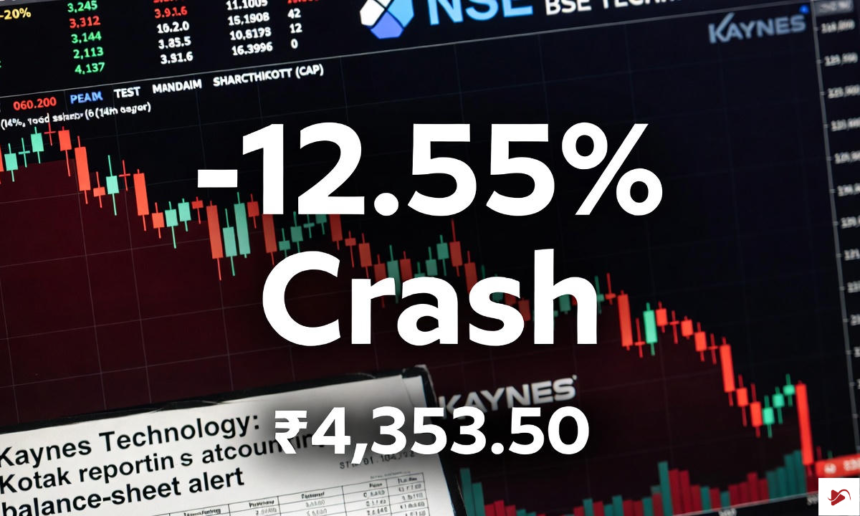
In a dramatic erosion of investor confidence that has sent shockwaves through India’s electronics manufacturing sector, shares of Kaynes Technology India Limited plummeted 12.55% to ₹4,353.50 on Friday, December 5, 2025, hitting an eight-month low amid heavy trading volumes on both NSE and BSE. The sharp decline, which saw the stock touch an intraday low of ₹4,343, came in the wake of a scathing research report by Kotak Institutional Equities that raised serious red flags about the company’s accounting practices, related-party transaction disclosures, and deteriorating balance sheet quality.
The Bengaluru-headquartered integrated electronics manufacturer, once a market darling that touched a 52-week high of ₹7,822 on January 1, 2025, has now crashed 44.4% from those peak levels, wiping out approximately ₹16,200 crore in market capitalization over the past ten months. The stock’s journey from multi-bagger status to troubled territory has left thousands of retail investors nursing significant losses while raising uncomfortable questions about due diligence, corporate governance, and the sustainability of India’s Electronics System Design and Manufacturing (ESDM) sector boom.
The Kotak Report: Uncovering Accounting Discrepancies and Missing Disclosures
The catalyst for Friday’s carnage was a comprehensive research report published by Kotak Institutional Equities on December 3, 2025, which meticulously detailed multiple accounting irregularities and disclosure gaps in Kaynes Technology’s financial statements. The brokerage’s forensic analysis of the company’s FY2025 filings, along with those of its subsidiaries Kaynes Electronics Manufacturing and Iskraemeco (the Slovenian subsidiary acquired in 2024), revealed troubling mismatches that question the accuracy and completeness of the company’s reported financial position.
Missing Related-Party Transactions Worth Hundreds of Crores
The most alarming finding in Kotak’s report centers on significant related-party transactions that appear on one entity’s books but are conspicuously absent from the corresponding entity’s disclosures—a fundamental accounting violation that undermines the reliability of consolidated financial statements.
The ₹180 Crore Purchase Mystery: According to Kotak’s analysis, Iskraemeco (the Slovenian subsidiary) reported purchases worth ₹180 crore from Kaynes Electronics Manufacturing Private Limited during FY2025. However, these transactions are not reflected anywhere in Kaynes Electronics Manufacturing’s related-party disclosures. This glaring omission raises critical questions: Did these transactions actually occur? If they did, why weren’t they disclosed by Kaynes Electronics Manufacturing? If they didn’t occur, why is Iskraemeco reporting them?
Year-End Balance Mismatches: The discrepancies extend beyond income statement items to balance sheet positions. Iskraemeco’s related-party disclosures show year-end payables of ₹320 crore to Kaynes Technology India Limited and ₹180 crore to Kaynes Electronics Manufacturing, alongside receivables of ₹190 crore from Kaynes Technology. Astonishingly, none of these substantial inter-company balances are reflected in the related-party disclosures of Kaynes Technology or Kaynes Electronics Manufacturing.
Aged Receivables Concern: Perhaps most concerning is Kotak’s observation that Iskraemeco’s related-party disclosures reveal almost all current receivables are due from the parent company, with ₹45.8 crore of total receivables being outstanding for over a year. This concentration of receivables from related parties, combined with significant aging, raises questions about the collectability of these amounts and whether they represent genuine business transactions or potential fund transfers designed to inflate revenues or manage cash flows.
Contingent Liabilities Balloon to ₹520 Crore
Adding to the litany of concerns, Kotak’s report highlighted that Kaynes Technology’s contingent liabilities ballooned to ₹520 crore in FY2025—representing a staggering 18% of the company’s net worth. This compares to ₹270 crore in FY2024, which represented 11% of net worth at that time. The near-doubling of contingent liabilities in a single fiscal year is highly unusual and typically signals either aggressive business expansion with associated legal/contractual risks, ongoing disputes that could materialize into actual liabilities, or accounting practices designed to keep certain obligations off the primary balance sheet.
Contingent liabilities, while technically off-balance-sheet items, represent potential future obligations that could significantly impact a company’s financial position if they materialize. For a company with a FY2025 net worth of approximately ₹2,889 crore, contingent liabilities of ₹520 crore represent a material risk that investors must factor into their valuation models.
High Working Capital Days: Cash Flow Warning Signal
Beyond the accounting discrepancies, Kotak’s report also flagged Kaynes Technology’s high working capital days—a metric that measures how long cash is tied up in the operating cycle before being converted back to cash through sales collection. High working capital days typically indicate either inefficient operations, aggressive revenue recognition practices that result in inflated receivables, or inventory buildup that may signal demand issues.
For an electronics manufacturing services (EMS) company like Kaynes, working capital management is crucial because the business model involves purchasing components, manufacturing products, and then collecting payment from customers—a cycle that can extend for months depending on customer payment terms and inventory turnover. When working capital days increase significantly, it often means the company is generating revenue on paper but not converting those sales into actual cash, which can create liquidity pressures and raise questions about the quality and sustainability of reported growth.
Market Reaction: Brutal Selloff and Brokerage Downgrades
The market’s response to Kotak’s revelations was swift and merciless. Kaynes Technology opened Friday’s trading session with a significant gap down and continued to slide throughout the day as investors rushed to exit positions. The stock tumbled 12.55% to close at ₹4,353.50, with intraday movements touching ₹4,343—the lowest level since April 2025.
The trading volumes told the story of panic selling: approximately 4.5 lakh shares changed hands on BSE alone, representing nearly 5.7 times the average daily volume of 79,121 shares over the past month. On NSE, volumes were similarly elevated at 9 million shares. This surge in selling pressure reflected not just retail investors cutting losses but likely also institutional investors reducing exposure following Kotak’s damaging report.
Kotak’s Harsh Verdict: Sell Rating with Limited Upside
Kotak Institutional Equities pulled no punches in its investment recommendation, maintaining a ‘SELL’ rating on Kaynes Technology with a price target of ₹5,760—implying merely 32.3% upside from the December 5 closing price of ₹4,353.50. More tellingly, this target represents a massive 26.4% downside from the stock’s recent trading levels in November when it was hovering around ₹6,300-6,400.
The brokerage’s rationale for the bearish stance centered on three key concerns:
1. Weak Base EMS Business Performance: Kotak noted that the core Electronics Manufacturing Services business, which forms the foundation of Kaynes’ operations, has been underperforming. While the company has been aggressively expanding into new areas like semiconductor assembly and testing (OSAT) and high-density interconnect PCBs, the traditional EMS business that generates the bulk of revenues appears to be facing headwinds.
2. Deteriorating Balance Sheet Quality: The combination of high working capital days, ballooning contingent liabilities, and questionable inter-company transactions paint a picture of a balance sheet under stress. Kotak’s analysis suggests that the company’s asset quality may not be as robust as headline numbers indicate.
3. Rich Valuation Despite Concerns: Even after the 44% decline from peak levels, Kotak values Kaynes’ core business at a FY27 PE (Price-to-Earnings) ratio of 55x—a valuation it considers “rich” given the operational and accounting concerns. For context, the company’s current PE ratio stands at approximately 105.60, implying that even at Kotak’s bearish target price, the stock would trade at premium valuations that may not be justified by fundamentals.
JPMorgan’s Warning: Don’t Catch the Falling Knife
Adding to the negative chorus, global investment bank JPMorgan issued a cautionary note warning investors against “bottom fishing” at current levels—a Wall Street term for attempting to buy stocks that have fallen sharply in hopes of catching the rebound. JPMorgan’s stark assessment: “Unresolved issues surrounding balance and cash flow, as well as the company’s questionable accounting are the key reasons why investors should not bottom fish the dip, at least for now.”
Interestingly, JPMorgan maintained its ‘Overweight’ rating and target price of ₹7,550 on Kaynes Technology, suggesting the bank believes in the company’s long-term potential despite near-term concerns. However, the brokerage acknowledged that the stock “lacks clear, strong catalyst from here till Q3 earnings,” implying that there are no immediate positive developments on the horizon that could reverse the negative sentiment or provide a floor for the stock price.
This cautious optimism reflects the dilemma facing many institutional investors: Kaynes operates in a strategically important sector with strong government support and long-term growth potential, but the near-term uncertainties around accounting practices and operational execution make it difficult to establish conviction at current levels.
ICICI Securities Highlights Disclosure Gaps
Adding another layer to the controversy, ICICI Securities corroborated Kotak’s findings regarding missing related-party disclosures. The brokerage’s independent analysis confirmed that related-party transactions reported by Iskraemeco do not find corresponding mention in the books of Kaynes Technology and Kaynes Electronics Manufacturing, lending credibility to concerns about the completeness and accuracy of the company’s consolidated financial reporting.
Kaynes Technology’s Response: Clarification Attempt Falls Flat
In response to the market turmoil triggered by the Kotak report, Kaynes Technology issued a regulatory filing on December 5, 2025, titled “Clarification On Summary Of Report Published By Kotak Institutional Equities Dated 03rd December 2025.” The filing attempted to address some of the concerns raised but failed to provide satisfactory explanations for the core accounting discrepancies that triggered the selloff.
The company’s clarification focused on explaining the nature of its contingent liabilities (₹520 crore), providing context around related-party omissions, and clarifying certain accounting treatments related to goodwill and intangibles arising from acquisitions. However, the response was notably vague on the specific transactions that Kotak highlighted as missing from related-party disclosures, leading many market participants to view the clarification as inadequate.
The tepid market reaction to Kaynes’ clarification—with the stock continuing to trade near its lows even after the filing—suggests that investors remain unconvinced that the company has adequately addressed the substantive concerns raised by Kotak’s forensic analysis.
Understanding Kaynes Technology: From Market Darling to Troubled Stock
To fully appreciate the magnitude of this crisis, it’s essential to understand Kaynes Technology’s business model, growth trajectory, and the factors that made it a market favorite before this dramatic reversal.
The Business: India’s Electronics Manufacturing Powerhouse
Kaynes Technology India Limited, incorporated in 2008 but with roots dating back to 1988, has positioned itself as one of India’s leading end-to-end Electronics System Design and Manufacturing (ESDM) service providers. The company offers comprehensive solutions spanning:
Conceptual Design: Engineering services to develop product concepts and prototypes
Process Engineering: Manufacturing process optimization and production line setup
Integrated Manufacturing: Full-scale production across multiple product categories
Life-Cycle Support: After-sales service, maintenance, and product upgrades
Diverse Industry Exposure
Kaynes serves a wide array of sectors, giving it diversified revenue streams:
- Automotive: Electronic components for vehicles, including EV systems
- Industrial: Automation equipment, power electronics, industrial IoT devices
- Aerospace & Defense: Mission-critical electronics for aviation and military applications
- Outer-Space: Satellite components and space-grade electronics
- Nuclear: Specialized electronics for nuclear power applications
- Medical Devices: Healthcare equipment and diagnostic systems
- Railways: Signaling systems and train control electronics
- Internet of Things (IoT): Connected devices and smart solutions
- Information Technology: Computing hardware and networking equipment
Strategic Positioning and Government Tailwinds
Kaynes operates in one of India’s most strategically important sectors. The Indian government’s Production Linked Incentive (PLI) scheme for electronics manufacturing, combined with the global trend toward supply chain diversification away from China (the “China Plus One” strategy), has created a once-in-a-generation opportunity for domestic ESDM players like Kaynes.
The company has aggressively expanded its capabilities and capacity to capitalize on these tailwinds, making significant investments in:
1. Semiconductor Assembly and Testing (OSAT): Entering the high-margin semiconductor backend services market to participate in India’s semiconductor ambitions
2. High-Density Interconnect PCBs (HDI PCBs): Manufacturing advanced printed circuit boards for sophisticated electronic devices
3. Capacity Expansion: Opening new manufacturing facilities in Pune, Manesar (Haryana), and expanding existing units in Mysore to accommodate growing order books
The Growth Story That Captivated Investors
Kaynes’ financial performance in recent quarters had been nothing short of spectacular, creating the momentum that drove the stock to its January 2025 peak:
Q2 FY26 Results (Quarter Ended September 2025):
- Consolidated Net Profit: ₹121.4 crore (up 102% year-on-year)
- Revenue from Operations: ₹906.2 crore (up 58% year-on-year)
- Order Book: ₹8,099.4 crore as of September 30, 2025 (up from ₹5,422.8 crore a year earlier)
Q1 FY26 Results:
- Net Profit: ₹74.61 crore (up 49.96% year-on-year)
- Revenue: ₹673.46 crore (up 33.63% year-on-year)
These impressive growth metrics—triple-digit profit growth and substantial order book expansion—justified premium valuations and attracted significant institutional and retail investor interest. The stock became a favorite among momentum investors and was widely recommended by brokerage houses as a pure play on India’s electronics manufacturing theme.
The IPO and Post-Listing Journey
Kaynes Technology made its stock market debut in November 2022 through an Initial Public Offering that raised ₹858 crore. The IPO comprised:
- Fresh Issue: ₹530 crore (9,028,960 shares)
- Offer for Sale: ₹328 crore (5,584,664 shares)
The listing was well-received, and the stock embarked on a remarkable bull run that saw it appreciate over 300% from its listing price to the January 2025 peak. This spectacular performance made Kaynes one of the best-performing IPO stocks of the 2022-23 period, generating significant wealth for early investors while attracting fresh capital from retail and institutional investors chasing momentum.
The Steep Decline: From ₹7,822 to ₹4,343
The magnitude of Kaynes Technology’s fall from grace becomes stark when examining the numbers:
52-Week High: ₹7,822 (January 1, 2025)
Current Price: ₹4,353.50 (December 5, 2025)
52-Week Low: ₹3,825.15 (February 11, 2025)
Decline from Peak: 44.4%
Market Cap Erosion: From ~₹52,000 crore to ~₹29,184 crore (loss of ~₹23,000 crore)
The Timeline of Trouble
October 7, 2025: Stock touches three-month high of ₹7,705, appearing to consolidate near peak levels
November 2025: Stock begins showing weakness, declining approximately 10% from October highs as whispers about accounting concerns begin circulating
December 3, 2025: Kotak Institutional Equities publishes damaging research report detailing accounting irregularities
December 5, 2025: Stock crashes 12.55% to ₹4,353.50, hitting eight-month low amid panic selling
Past One Month Performance: Down 31% (while BSE Sensex rose 2.3%)
Past Three Months Performance: Down 41% from October high of ₹7,705
The speed and severity of the decline—losing 31% in just one month and 41% in three months—reflects the binary nature of accounting concerns. Unlike operational challenges that develop gradually and can be addressed over time, questions about accounting integrity and financial reporting accuracy trigger immediate loss of confidence that is extremely difficult to restore.
Impact on Shareholders: Wealth Destruction Across Investor Categories
The Kaynes Technology debacle has inflicted significant financial pain across different categories of shareholders:
Retail Investors
Thousands of retail investors who bought the stock at higher levels, particularly those who entered near the ₹7,000-7,800 range in late 2024 and early 2025, are now sitting on losses exceeding 40%. Many of these investors were attracted by the stock’s momentum and the compelling India electronics manufacturing story, often investing substantial portions of their savings based on recommendations from market experts and financial influencers.
For a retail investor who invested ₹5 lakh at ₹7,500 per share (approximately 67 shares), the current market value would be around ₹2.92 lakh—a loss of ₹2.08 lakh or 41.6% in less than a year. These aren’t just numbers; they represent real people’s savings, retirement funds, and financial goals that have been significantly damaged.
Institutional Investors
Large institutional investors—mutual funds, insurance companies, and foreign portfolio investors—who collectively hold approximately 23.6% of Kaynes Technology (based on latest shareholding patterns) have also suffered major mark-to-market losses. Several prominent mutual fund schemes that had built substantial positions in Kaynes as part of their manufacturing and India growth themes now face difficult decisions about whether to average down, hold for recovery, or exit to cut losses.
The erosion in value affects not just the fund managers’ performance metrics but also millions of mutual fund unit holders whose portfolio NAVs decline when holdings like Kaynes crash.
Promoters
The promoter group, which holds approximately 53.5% stake in Kaynes Technology, has seen its wealth decline by over ₹12,000 crore as the stock crashed from peak to current levels. While promoters typically have longer investment horizons and aren’t focused on near-term price movements, the reputational damage from accounting allegations can be far more consequential than temporary wealth erosion.
What This Means for India’s ESDM Sector
The Kaynes controversy arrives at a critical juncture for India’s Electronics System Design and Manufacturing industry, which has been positioned as a strategic priority by the government and a key beneficiary of global supply chain restructuring.
Sector-Wide Implications
1. Investor Caution: The accounting concerns at Kaynes may prompt investors to apply more stringent due diligence to other ESDM companies, potentially impacting valuations across the sector. Stocks of competitors and peers may face scrutiny as investors question whether similar accounting practices exist elsewhere.
2. Regulatory Attention: The controversy could attract increased regulatory oversight from SEBI (Securities and Exchange Board of India) and potentially trigger stricter enforcement of accounting standards and disclosure requirements for companies in high-growth sectors.
3. Credibility Challenge: At a time when India is trying to position itself as a reliable alternative to China for electronics manufacturing, accounting scandals at prominent domestic players undermine the sector’s credibility with global customers and partners.
4. Valuation Reset: The premium valuations that ESDM stocks have commanded may need to be reassessed if investors conclude that aggressive growth has been achieved partly through accounting engineering rather than purely through operational excellence.
Government’s PLI Scheme at a Crossroads
The Production Linked Incentive scheme, under which companies like Kaynes have received or are eligible for substantial government support, may require enhanced monitoring mechanisms to ensure that beneficiaries are not just showing impressive growth on paper but actually building sustainable, world-class manufacturing capabilities with proper corporate governance.
The Path Forward: What Kaynes Must Do
For Kaynes Technology to restore investor confidence and rebuild its tarnished reputation, the company must take decisive steps:
Immediate Actions Required
1. Comprehensive External Audit: Commission an independent forensic audit by a Big Four accounting firm to examine all related-party transactions, inter-company balances, and accounting treatments. Publish findings transparently.
2. Detailed Public Clarification: Issue a comprehensive statement addressing each specific concern raised by Kotak, with documentary evidence supporting the company’s position. Vague regulatory filings won’t suffice.
3. Strengthen Corporate Governance: Enhance board independence, strengthen audit committee oversight, and potentially bring in external experts to review and improve financial reporting processes.
4. Management Engagement: The CEO and CFO should engage directly with institutional investors and analysts in detailed conference calls or meetings to address concerns and rebuild trust.
Medium-Term Priorities
5. Demonstrate Operational Excellence: Focus on delivering strong operational performance in Q3 and Q4 FY26, showing that underlying business fundamentals remain solid despite accounting controversies.
6. Simplify Corporate Structure: If inter-company transactions and consolidation are creating confusion, consider simplifying the corporate structure to improve transparency.
7. Enhanced Disclosure Practices: Go beyond minimum regulatory requirements in disclosing related-party transactions, contingent liabilities, and other areas where questions have been raised.
Investment Perspective: To Buy, Hold, or Sell?
Current and prospective investors face difficult decisions about how to approach Kaynes Technology at this juncture:
The Bear Case (Reasons to Avoid or Sell)
- Unresolved accounting concerns that question financial statement reliability
- High contingent liabilities that could materialize into actual obligations
- Rich valuations even after 44% decline (PE still over 100x)
- Lack of clear near-term catalysts for recovery
- Reputational damage that may impact customer relationships and new order wins
- Potential for further regulatory scrutiny or investigations
The Bull Case (Reasons to Hold or Buy)
- Strong underlying business fundamentals with 58% revenue growth in Q2
- Robust order book of ₹8,099 crore providing revenue visibility
- Operates in strategically important sector with long-term tailwinds
- Government support through PLI scheme and China+1 trend
- JPMorgan maintains Overweight rating with ₹7,550 target (73% upside)
- Stock trading near 52-week low could present buying opportunity if concerns prove overblown
The Pragmatic Approach
For conservative investors, the prudent course is to stay away until:
- The company provides satisfactory clarifications on accounting concerns
- Independent audits validate the company’s financial statements
- At least 2-3 quarters of clean, transparent financial reporting restore credibility
For risk-taking investors who believe the concerns are overblown, consider:
- Waiting for Q3 FY26 results (expected in late January 2026) to assess management’s response
- Dollar-cost averaging rather than lump-sum investment to manage downside risk
- Position sizing appropriate to the elevated risk profile
For existing shareholders, the decision depends on:
- Your entry price and current loss level
- Conviction in the company’s long-term prospects
- Risk tolerance and ability to withstand further volatility
Conclusion: A Cautionary Tale of Growth, Governance, and Trust
The Kaynes Technology saga serves as a stark reminder that in equity investing, corporate governance and accounting integrity matter as much as business fundamentals and growth prospects. A company can have impressive revenue growth, strong order books, and operate in a strategically important sector, but if investors lose confidence in the reliability of financial statements, all those positives become meaningless.
As the stock languishes at eight-month lows with ₹4,353.50 representing a 44% haircut from peak valuations, Kaynes Technology finds itself at a critical crossroads. The coming weeks and months will determine whether this is a temporary crisis of confidence that the company can overcome through transparency and improved governance, or whether it represents deeper structural issues that will permanently impair the company’s growth trajectory and valuation multiples.
For India’s broader electronics manufacturing ambitions, the Kaynes controversy is a wake-up call. As the sector scales up with government support and global attention, maintaining the highest standards of corporate governance, financial reporting, and business ethics becomes non-negotiable. The sector’s long-term credibility—and India’s positioning as a reliable manufacturing destination—depends on it.
Investor Advisory: This article is for informational purposes only and should not be construed as investment advice. Kaynes Technology stock carries high risk given unresolved accounting concerns. Investors should conduct thorough due diligence, consult certified financial advisors, and invest only amounts they can afford to lose in high-risk, high-volatility stocks. Past performance is not indicative of future results.
Key Data Summary (As of December 5, 2025)
Current Price: ₹4,353.50
52-Week High: ₹7,822.00 (Jan 1, 2025)
52-Week Low: ₹3,825.15 (Feb 11, 2025)
Market Cap: ₹29,184 crore
P/E Ratio: 105.60
P/B Ratio: 8.54
Promoter Holding: 53.5%
Volume (NSE+BSE): 9 million shares
Day’s Decline: -12.55%
Month’s Decline: -31%
3-Month Decline: -41%